Great Serves on the WTA Tour: Sabalenka, Rybakina and the Next Generation
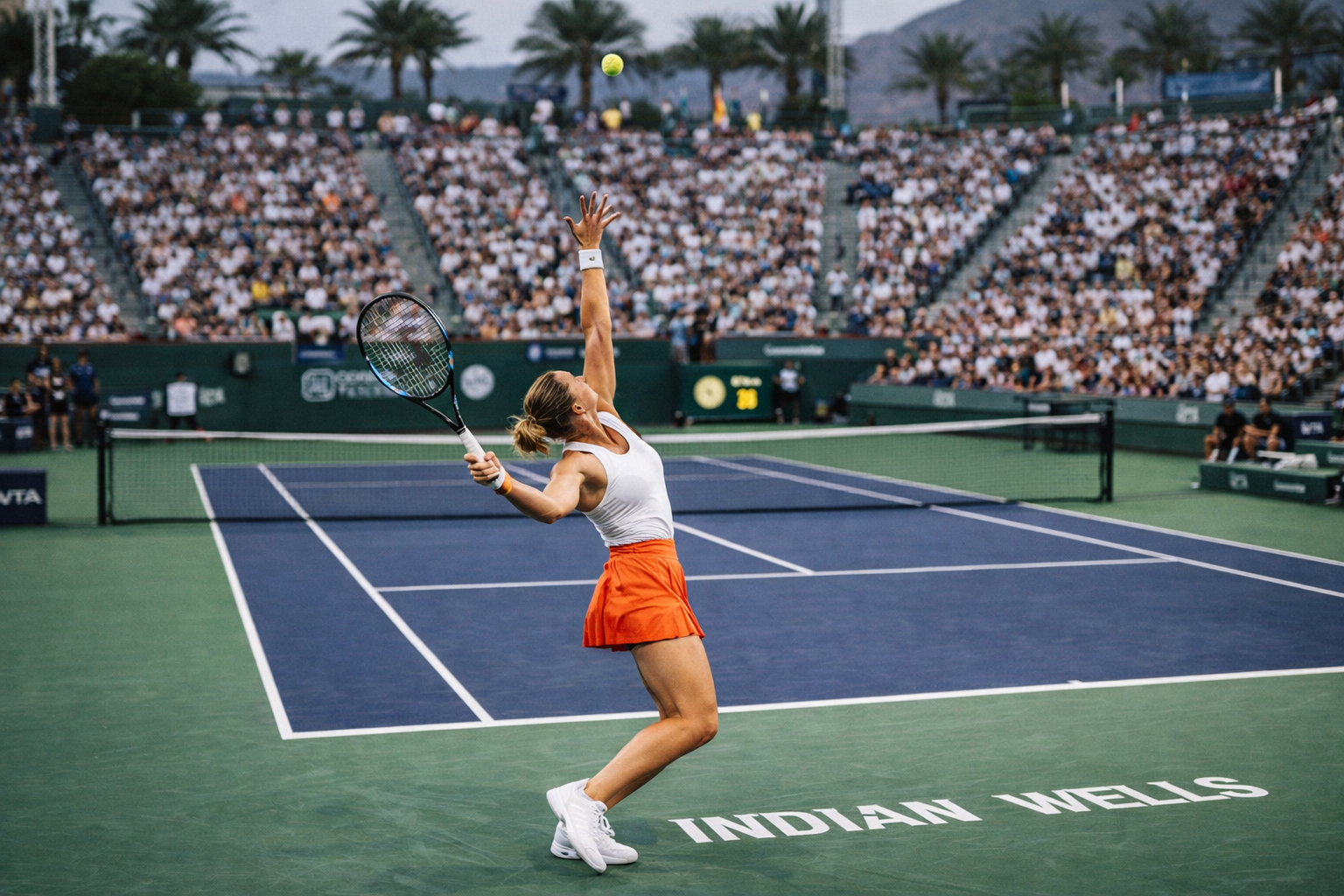
At the very top of the WTA Tour, the pattern is hard to miss: the best players are also the best servers. In modern tennis, holding serve consistently is not merely an advantage — it is often the foundation of championship success.
Across the last 52 weeks, two names sit clearly ahead of the pack when it comes to service dominance: Aryna Sabalenka and Elena Rybakina. Their numbers tell a compelling story about why the serve remains the most influential shot in tennis.
After all, players serve roughly half the time in any match. It is the only stroke capable of winning a point before the opponent even touches the ball. If tennis were played by perfectly programmed machines delivering an ace every time, a match could theoretically last forever in a first‑set tiebreak.
Humans, fortunately, require a little more nuance.
The Numbers Behind the Best Serves on Tour
Elena Rybakina currently leads the tour in service efficiency. Over the past 52 weeks she has won an impressive 65.3% of all service points. She delivers an ace on 10.5% of points while committing just 3.8% double faults.
- First serve points won: 75.2%
- Second serve points won: 52.1%
- Service games held: 83%
These numbers help explain her steady climb up the rankings and recent success, including titles in Ningbo, the WTA Finals, and the Australian Open.
Aryna Sabalenka sits just behind her with equally formidable statistics.
- Service points won: 62.3%
- Ace rate: 6.2%
- Double faults: 3.3%
- First serve points won: 69.2%
- Second serve points won: 50.9%
- Service games held: 79%
In early 2026, Sabalenka has been even more dominant, holding serve in 86% of her service games — helped by an excellent start to the season that included a run to the Australian Open final.
Does Height Matter?
There is a noticeable physical trait shared by many of the tour’s biggest servers: height.
Rybakina stands at 1.84m and Sabalenka at 1.82m, placing them among the tallest players in the top tier of the tour. Height allows players to strike the ball from a steeper angle, increasing both power and margin over the net.
But height alone does not create a great serve. Technique, timing and repeatability under pressure ultimately matter more than raw physical advantage.
Power vs Precision
Professional women’s tennis typically sees first serves travelling between 105 and 112 mph. The fastest deliveries can approach 120 mph in match play.
The fastest serve ever recorded on the women’s tour reached 136 mph in 2018, although not by a top‑ranked player. Icons like Venus and Serena Williams have also produced serves near the 130 mph mark.
But velocity alone solves very little. A 120 mph serve that misses the box counts for nothing.
The true art of serving lies in combining controlled power with accuracy — the balance both Sabalenka and Rybakina have refined over time.
How Sabalenka Transformed Her Serve
Sabalenka’s serve today looks polished and reliable, but it was not always so. Five years ago she struggled with double faults and inconsistency.
The transformation came through biomechanical adjustments and a renewed mental approach.
- Ball toss adjustment – keeping the tossing arm up longer and positioning the toss slightly to the right for better balance.
- Smoother motion – removing a hitch in the service action to create a fluid, repeatable swing.
- Greater power generation – improved shoulder rotation and stronger leg drive.
- Mental commitment – trusting the technique and eliminating the fear of double faults.
The result was immediate: more consistent serving and eventually her first Grand Slam title.
The Development Path for Young Players
For rising players on tour, the serve is often the last piece of the puzzle.
Talents such as Iva Jovic, Alexandra Eala, Maya Joint, Sara Bejlek and Tereza Valentova have already broken into the top 50 before the age of 21. Their groundstrokes and competitive instincts have carried them this far.
The next step — and often the most difficult — is turning the serve into a genuine weapon.
Alex Eala: A Serve Still Under Construction
One of the most talked‑about young players on tour right now is Alex Eala. With a passionate global fanbase and enormous potential, she has already shown flashes of what she might become.
Her service numbers, however, highlight the gap between promising newcomer and established contender.
- Service points won: 54.8%
- First serve points won: 58.9%
- Second serve points won: 46.5%
- Ace rate: 1.2%
- Double faults: 4.0%
- Service games held: 60.8%
Compared with the tour’s elite servers, her serve currently generates too few free points.
Three Areas for Improvement for Alex Eala
1. Increasing First Serve Power
Eala recently clocked a 105 mph first serve against Coco Gauff in Indian Wells, a promising sign. However, her typical first serve sits between 90 and 100 mph — below the tour average.
Strengthening her legs and shoulders will allow more energy transfer through the service motion, creating both speed and penetration.
2. Refining the Ball Toss
The ball toss determines nearly everything about a serve — height, contact point and spin.
As a left‑handed player, Eala already has a natural tactical advantage, especially when swinging serves wide on the ad court. But varying the toss could allow her to deploy multiple serve types: flat down the T, slice wide, or heavy kick into the body.
3. A More Assertive Second Serve
Against elite returners, a passive second serve quickly becomes a target. Developing a heavier kick serve or more aggressive placement would prevent opponents from dictating points immediately.
The Reality of Moving Up the Rankings
Young players often arrive on tour after dominating ITF or lower‑tier WTA events. At that level, opponents make more errors and matches can be won without a world‑class serve.
At the top level, however, the margin for error shrinks dramatically.
When facing players inside the world’s top 16 — in form and confident — victory usually requires a player’s absolute best tennis.
For Alex Eala and others of her generation, that journey is only beginning. With several years ahead to refine her serve, the blueprint provided by Sabalenka and Rybakina offers a clear path forward.
Patience, technical refinement and belief tend to reward those willing to do the work.
The serve, after all, remains tennis’s most powerful opening statement.

Dan has followed professional tennis for many years with a particular focus on performance trends, match dynamics, and statistical analysis. He competed at national level as a junior, an experience that continues to inform his understanding of technique, tactics, and the physical and mental demands of elite competition. He has a particular interest in how player psychology influences decision‑making, momentum, and match outcomes.
He has attended numerous national and international tournaments alongside Katie, prioritising early‑round and outside‑court matches where emerging players and tactical developments are most visible. This on‑site exposure informs his analytical approach, grounding data‑led insights in live match observation rather than abstraction.
As a co‑founder of ChalkdustMedia, Dan is responsible for the platform’s analytical and statistical coverage, entirely focused on the WTA. His work focuses on translating complex performance data into clear, accessible insight, while also considering the psychological factors that shape form, resilience, and competitive consistency.
Dan’s approach combines consistency, objectivity, and a long‑term view of the sport, supporting ChalkdustMedia’s goal of delivering informed, independent tennis coverage under a single editorial banner.
How tennis players adapt to clay courts during the European swing